-
Free Shipping
-
Contact UsEmail sales@bolioptics.com

| Optical System | Finite |
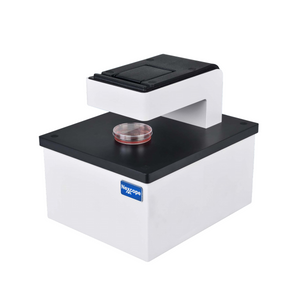
| Notes | 1)Transmittance lighting 3W 627nm Red LED.2)Fixed stage, compatible with various culture bottles and culture dishes.3)Semi-Plan phase contrast objective 10x.4)Z-axis Travel: Upper 7mm, lower 1.5mm; electric focus, auto-focus; manual 2mm/rev.5)Camera 5.0 Mega CMOS Black & White USB3.0 Camera analysis software.6)Analysis software Satisfy the basic functions of photo, video and time-lapse photography.7)Size 220mm X 264mm X 240mm (W X D X H) |
Technical Info
| Digital microscope is the general term for microscope that can convert an optical image into a digital image, and usually does not specifically refer to a certain type of microscope. It should be noted however that most microscopes can be mounted with cameras and display devices to change to digital microscope. Microscopes in the visible range, from the digital imaging point of view, all use CCD or CMOS sensors to image the optical signal as an electric signal on a computer or display. However, the difference between various kinds of digital microscopes mainly comes from the optical microscope itself, so it is necessary to look at the imaging effect and function of the optical part in order to select the type of digital microscope. From the classification point of view, digital microscopes can be divided into: digital biological microscopes, digital stereo microscopes, etc. It should be noted that due to the variety of lenses, ordinary lenses or microscopes, if mounted with a digital camera, can all become a digital microscope. At present, the trend of digital microscopes is not only to present simple digital images, but to collect, process and analyze images through back-end software, especially for image measurement, comparison, judgment, and large-format scanning and splicing, and three-dimensional synthesis and so on, these aspects have been widely developed and applied. |
| Microscopes and components have two types of optical path design structures. One type is finite optical structural design, in which light passing through the objective lens is directed at the intermediate image plane (located in the front focal plane of the eyepiece) and converges at that point. The finite structure is an integrated design, with a compact structure, and it is a kind of economical microscope. Another type is infinite optical structural design, in which the light between the tube lens after passing the objective lens becomes "parallel light". Within this distance, various kinds of optical components necessary such as beam splitters or optical filters call be added, and at the same time, this kind of design has better imaging results. As the design is modular, it is also called modular microscope. The modular structure facilitates the addition of different imaging and lighting accessories in the middle of the system as required. The main components of infinite and finite, especially objective lens, are usually not interchangeable for use, and even if they can be imaged, the image quality will also have some defects. The separative two-objective lens structure of the dual-light path of stereo microscope (SZ/FS microscope) is also known as Greenough. Parallel optical microscope uses a parallel structure (PZ microscope), which is different from the separative two-object lens structure, and because its objective lens is one and the same, it is therefore also known as the CMO common main objective. |